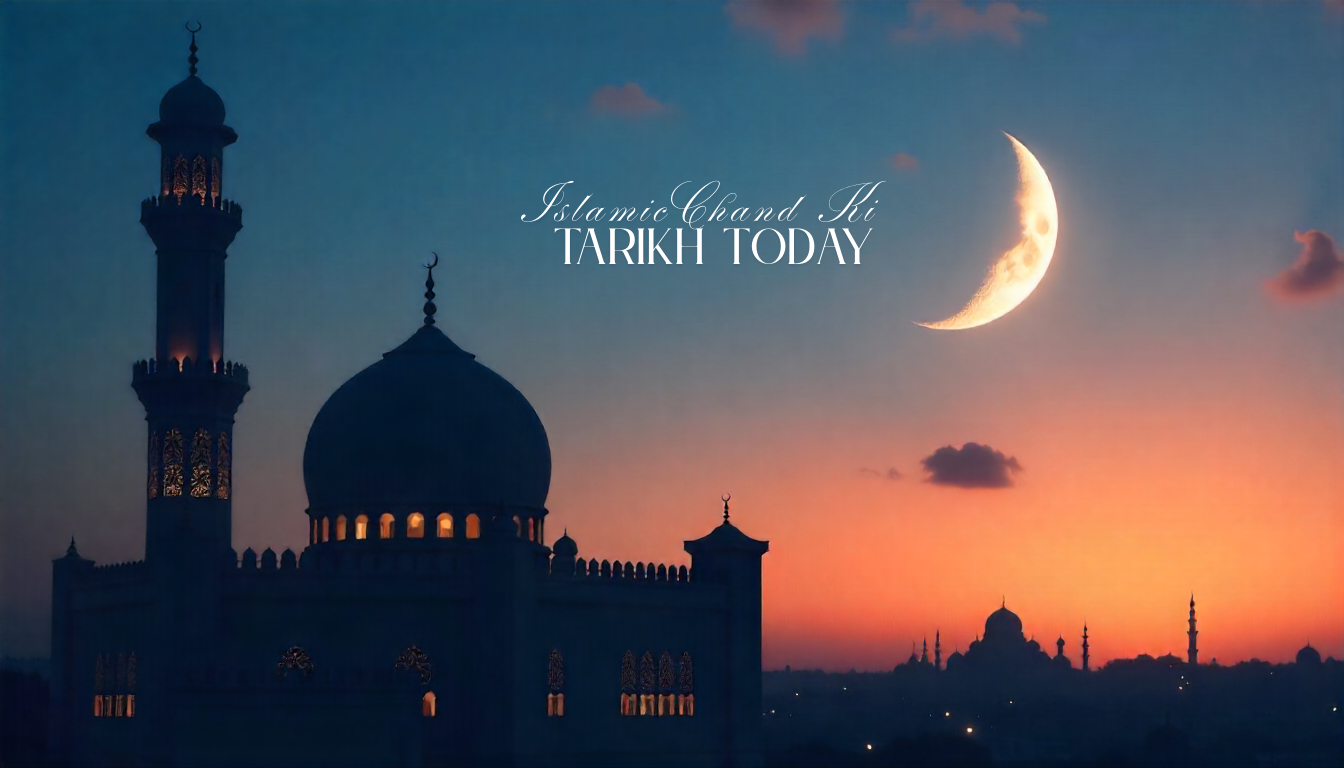
The Hijra or Islamic calendar has been central to Muslim culture and religion since 1,400 years ago. Muslims around the world today use the Islamic chand ki tarikh today to calculate significant religious holidays and festivals in addition to their day-to-day religious observances. As we navigate through the modern digital age, understanding the current Islamic date becomes more crucial than ever for maintaining our connection to Islamic traditions and heritage.
What is Chand Ki Tarikh?
The literal meaning of chand ki tarakh in Urdu and Hindi is the date of the moon or rather the lunar calendar system depicted in Islam. This type of timekeeping is entirely lunar, and is therefore completely unlike the solar Gregorian calendar applied in most of the world today. The Islamic chand ki tarikh is now more than a date; it also is a spiritual relationship with the nonhuman world and the divine order created by Allah.
The Islamic calendar has 12 lunar months with 29 days in each month or even 30 days in each month depending on the visibility of the new moon. The number of days of this lunar year is about 354 or 355 days or 10-11 days less than the solar year. Such difference implies that every year, Islamic months and festivals will arrive precisely earlier than Gregorian one, and this particular cyclic phenomenon recurs afterwards, once after 33 years.
Current Islamic Date Today
On this eleventh of September, 2025 the chand ki tarikh of today will differ with geographical differences in moon sighting. In India, Pakistan, and Bangladesh, the current Islamic date is 7 Rabi al-Awwal 1447 AH (After Hijra). But in Saudi Arabia and certain other Middle Eastern nations the date can be 9 Rabi al-Awwal 1447 AH. The reason is that the Islamic authorities in each country do their own moon sighting to ascertain the start of every lunar month.
Recent Muslim date is calculated by the National Moon Sighting Committes in that respective country where Moon Sighting is put to close attention where the real dates of that particular dates are announced. This classical process of observing the moon has remained intact during the entire Islamic history and has preserved the originality and religious value of the Islamic system of time.
Islamic calendar months.
Understanding the Islamic chand ki tarikh today requires knowledge of the twelve sacred months that make up the Islamic year. Every month is particularly important and regulates different religious celebrations:
Muharram is one of the four holy months of the Islam religion, and it is the Islamic New Year. It also has Ashura, one of the most significant religious holidays among Muslims all over the world. Safar is the month after Muharram and it is believed that the Arab tribes used to travel and trade during this month. The current month, Rabi al-Awwal, is of the greatest importance as it is the month of the year when the Prophet Muhammad (Peace Be Upon Him) was born and it is therefore very holy to Muslims.
The spring season of the Islamic calendar is followed by Rabi al-Thani, Jumada al-Awwal and Jumada al-Thani, which symbolize the dry season. Another holy month, the month of Allah, is called Rajab, and during this month combat was always prohibited. Shaban is a month before Ramadan, and Ramadan is the most sacred month when people fast, pray, and contemplate.
Eid al-Fitr marks the end of Ramadan and it starts Shawwal. The third holy month is Dhu al-Qadah, and the last month is Dhu al-Hijjah, the Hajj pilgrimage and Eid al-Adha.
How to Determine Chand Ki Tarikh Today
Finding the accurate chand ki tarikh today in our digital age has become remarkably convenient through various online platforms and mobile applications. These digital technologies update the the Islamic chand ki tarikh today in real-time, so Muslims across the globe can remain in touch with their lunar calendar requirements, no matter where in the world they happen to be.
The conventional ways of calculating the Islamic date were through the direct observation of the phases of the moon by the religious leaders. New moon The start of a new month would be announced by local mosques and Islamic centers due to the sighting of the new crescent moon. Even though the traditional technology is still applied to-day, the modernistic technology substituted such traditional methods with the astronomical choices, which provide a very precise answer.
It is done by watching the western horizon immediately after the sunset on the 29th day of every Islamic month. When the new crescent moon shines, then the new month commences the next day. Otherwise, the month at hand will run to the end of one day and then the 30 days will be completed before the new month begins. By this natural mechanism, the existing Islamic calendar has never gone out of step with the real lunar phases.
Local differences between Islamic Date determination.
One fascinating aspect of understanding Islamic chand ki tarikh today is recognizing how geographical differences affect date determination across different Muslim countries. The differing chand ki tarikh presently existing between regions is as a result of the curve of the earth and the relative position of the moon with regards to various locations in our planet.
In South Asian nations such as India, Pakistan and Bangladesh, the Islamic date tends to be one to two days behind the Middle Eastern nations such as Saudi Arabia. This opposition is on the bases of the sighting of the moon in the area and the parietal space. Naturally, on a day when Saudi Arabia could possibly mark 9 Rabi al-Awwal 1447 AH, the chand ki tarikh today in India could still be 7 Rabi al-Awwal 1447 AH.
Such a regional variation poses some intriguing questions to all the Muslim population of the globe, particularly in terms of establishing the festivals and religious holidays dates. Most Muslim groups use the local moon sighting authorities, but some tend to use the date stated in Saudi Arabia particularly during significant festivals such as Eid al-Fitr and Eid al-Adha.
Access to Islamic Calendar and Digital Revolution.
Nowadays Muslims are reaching information about the Islamic chand ki tarikh through the digital revolution. There are many websites, mobile apps and other digital platforms that allow one to get instant access to the correct Islamic dates, including prayer times, festival notification, and religious advice.
These internet technologies have rendered it extremely simple to keep in touch with their religious calendar among Muslims in non-Muslim nations. In New York, London, and Tokyo, you can always have a quick look at the current Islamic date to plan all those religious engagements. This availability has enhanced the capability of the global Muslim community to practice co-ordinated religious activities regardless of geographical barriers.
Islamic calendar applications in common use today typically have built-in functionality such as automatic location lookup, support of multiple country-specific Islamic dates, calculation of prayer times, and notification of festivals. These in turn make sure that today the Islamic chand ki tarikh is still visible and attainable by Muslims who still find themselves in the current world and are able to fulfill their religious duties and obligations.
Is the Appropriate Date Knowledge of Importance?
It is important, both for religious and practical reasons, to know the exact chand ki tarikh of the Muslim religion today. All Islamic worship time such as the five prayers a day, the weekly prayers on Fridays and the special religious observances are all linked to the lunar calendar system. There are also significant Islamic holidays, fasting times, and pilgrimage times that rely solely on the correct calculation of the lunar dates.
To make socially significant planning decisions and conduct business, it is important to know the present Islamic date to prepare Muslims communities to celebrate religious holidays, arrange family reunions, and coordinate communal events. The Hijri calendar is also used by many Islamic financial institutions in various transactions and contracts, and correct date knowledge is vital in economic operations in Muslim communities.
A part of personal spiritual development that is realized today through the chand ki tarikh is very critical. Islamic dates are used by many Muslims as a way of keeping track of their religious observances, like voluntary fasting on particular days, special prayers on holy months, and spiritual retreat during special lunar phases.
Worth of Islamic Calendar knowing as instruction.
The significance of teaching the Islamic chand ki tarikh to the younger generations today is more than religious education. The analysis of a lunar calendar system offers some mathematical and astronomical understanding of celestial mechanics and the natural cycles with the help of which human peoples lived thousands of years ago.
Islamic calendar system reveals the high level of astronomic knowledge of initial Muslim scientists and their role in the development of world science. A student who learns about chand ki tarikh today gains interest in the historical contributions of Islamic civilization to the field of mathematics, astronomy, and sciences of time.
In the Muslim world, more and more educational establishments are including the learning of the Islamic calendar in their teaching programs, as a way of enabling students to retain cultural links as they engage in modern education. This combination strategy will help retain Islamic chand ki tarikh as useful in the present world since the world is becoming more globalized and this will hopefully be of great use to future generations.
Problems and Remedies in the Postmodern Era.
Modern Muslims have some problems will preserving the correct understanding of the Islamic chand ki tarikh to this day as they live in a society that largely follows the Gregorian calendar. Islamic lunar scheduling clashes with work schedules, school schedules, and social commitments, so it has to be carefully balanced and planned.
Technology has brought new answers to these challenges in the form of coordinated digital mediums that perfectly merge the two calendar systems. My devices can now support two calendars at a time, displaying Gregorian and Islamic dates, so Muslims can easily use their devices now.
The community groups and mosques are important in course of delivering the correct information about the present Islamic date and assist the members in organizing religious functions beneath greater social frameworks. These institutions mediate between the modern and traditional ways of life.
Assimilation in Futures and Technology.
As we advance further into the digital age, the methods for determining and sharing information about the Islamic chand ki tarikh today continue to evolve. It is thought that artificial intelligence and machine learning technologies are developed to make the lunar predictions and automated Islamic calendar systems even more accurate.
Augmented reality applications could come in the future, which replaces the Islamic date with reality based applications, with the current Islamic date as visible and available as any current computer based information. These new developments in technology will help cement the relationship between Muslim communities and their lunar calendar tradition.
Making Islamic calendar systems compatible with international timekeeping systems is a potential game changer in the way Muslim communities organize international events, business meetings, and religious events. These would help keep the Islamic chand ki tarikh at the heart of Muslim life yet on par with the needs of the modern globalized society.
Frequently Asked Questions
What does Chand Ki Tarikh mean and how is it different from the regular calendar?
Cand sika, official name Chand ki tarikh in Urdu and Hindi, is the numeral based system of the Islamic lunar calendar. The Gregorian calendar operates using the yearly revolution of the sun, and has 365 days per year; the Islamic calendar uses the phases of the moon, and has 354-355 days per year. This implies that yearly the Islamic months change about 10-11 days before the solar calendar dates do. The Islamic chand ki tarikh today represents a connection to natural lunar cycles that Muslims have followed for over 1,400 years.
How can I find out the current Islamic date today?
You can find the current Islamic date on multiple websites of the Islamic calendar, mobile applications, a local mosque, etc. The real-time updates are available in the popular sites such as IslamicFinder, HamariWeb and other local Islamic calendar sites. Many smartphone apps automatically detect your location and show the accurate chand ki tarikh today for your specific region. It is important to remember that depending on local moon sighting methods, the difference in the Islamic date may be 1-2 days between countries.
How come that various countries have various Islamic dates of a single day?
The variation in Islamic chand ki tarikh today across different regions occurs because each country conducts its own moon sighting to determine the beginning of new lunar months. Nations such as Saudi Arabia could be a day or two ahead of South Asian nations such as India, Pakistan, or Bangladesh. It is because the moon is not visible everywhere at the same time and the choices of the local religious representatives. Each nation’s moon sighting committee announces their official dates, which is why the chand ki tarikh today can differ between locations.
Why do we need to know the actual Islamic date?
Exact Islamic chand Ki tarikh is vital knowledge today to conduct the religious duties rightly. Numerous Islamic customs are attributed to a particular date in the calendar, such as the daily prayers, weekly prayers on Friday, day of fasting every month, and festivals such as Ramadan and Eid. The existing method in the Islamic calendar is also useful when Muslims organize some religious events, calculate the amount of Zakat money to be paid and observe prescribed fasting days. Also, a lot of Islamic business deals and contracts are officially recorded using Hijri dates.
What are the months of the Islamic calendar and how many are there?
Islamic calendar is 12 lunar months: Muharram, Safar, Rabi al-Awwal, Rabi al-Thani, Jumada al-Awwal, Jumada al-Thani, Rajab, Shaban, Ramadan, Shawwal, Dhu al-Qadah and Dhu al-Hijjah. Every month has 29 days or 30 days according to the moon sighting. When you know the names of these months, you can start to understand why the chand ki tarikh today better, and can organize the major religious holidays of the Islamic year.
Are Islamic months able to contain 28 or 31 days as Gregorian months?
No, the Islamic months are strictly set at 29 days or 30 days depending on real moon observation. In contrast to Gregorian months of 28, 30 or 31 days, Islamic months are based on the natural lunar cycle. When the new crescent moon is sighted by official moon sighting committees, it is determined that it is 29 or 30 days later. The natural system makes sure that the Islamic chand ki tarikh is the one that exists today and may be said to be the same lunar calendar that was invented back in the days of Prophet Muhammad.
What will happen in case the moon does not rise on the 29th of an Islamic month?
In Islamic months where the new crescent moon does not appear on the 29th day, the given month automatically becomes 30 days. It is usually on the night of the 29th day that the religious leaders and the moon sighting committees come together and look at the western horizon at night, immediately after the sun has set. When no crescent is observed they declare that the present month will be 30 days before the next month. This customary navigation will render the present Islamic date correct based on verifiable heavenly observations and not merely various mathematic computations.
Are there any months which are regarded as being more holy than others according to the Islam religion?
Yes, there are four months in the Islamic calendar regarded as holy: Muharram, Rajab, Dhu al-Qadah and Dhu al-Hijjah. These two months are religious months and traditionally, it was during such months when fighting was prohibited in pre-Islamic Arabia. Further, Ramadan is believed to be the holiest month of worship and spirituality and Rabi al-Awwal is the most important month since Prophet Muhammad was born in this month. Knowledge of the sacred months of the Islamic chand ki tarikh in current times enables Muslims to be informed of the right religious holidays and religious practises.
What is the impact of the Islamic calendar on the date of festivals every year?
Since Islamic lunar year is 10-11 days short of solar year, the shift of Islamic festivals is earlier every Gregorian calendar year. As an example, when Ramadan falls in May this year, it will probably be in April or late in March the next year. This changing pattern implies that Islamic festivals will go through all the seasons in a cycle of about 33 years. Chand ki tarikh is what now calculates any precise day when these festivals would take place and as such it is the responsibility of Muslim communities worldwide to ensure they keep abreast of the correct information regarding their lunar calendar.
Would technology be able to substitute the traditional moon sighting to establish Islamic dates?
Although modernity offers the most accurate astronomical computations when it comes to predicting the phases of the moon, some Islamic scholars and communities still want to keep their customary moon sighting methods and use technology as a supplement. Technology is a useful aid to preparation and verification, yet the religious and cultural value of community moon sighting is also relevant to most Muslims. In the current day the Islamic chand ki tarikh, though the customary manner of observation is added, yet the modern day digital delivers the necessary harmonization between observing the Islamic calendar in the ways it always has, the days, but at the comfortable digitization a currently present worth of the platform brought about by use of the digital mode to give the appropriate date of the Islamic calendar.
Conclusion
Knowing the Islamic chand ki tarikh nowadays is far more than keeping track of the present day date, it is the recognition of the Islamic history, way of life and sense of community that has continued through time and enabled the Muslim world to survive the past fourteen hundred years. In our quest to contribute positively to the world by exploring the challenges of our world today and moving through the layers of Islamic life with awareness of the present Islamic date keeps the religious and cultural practices alive and relevant to the times as we adjust to the differences of the present.
The chand ki tarikh is still used today by millions of Muslims around the world in the daily spiritual exercises, celebration of their festivals, and all other community activities. Still, the Islamic assembly or the calendar arrangement remains in place due to the fact that those traditional modes of monitoring the moon, as well as the existing digital technologies guarantee that the generations to come will also be able to access that ancient wisdom.
Whether in the old system (mosque announcements) or new (smart phone apps) the Islamic chand ki tarikh, when utilized today, highlights a constant reminder of how we connect to the natural world, how we use divine guidance and how we are a part of the larger Muslim world and cultural in-commonality which keeps these time keeping practices consistent, world-wide, in all of humanity.